Jim Crow Wisdom by Jonathan Scott Holloway
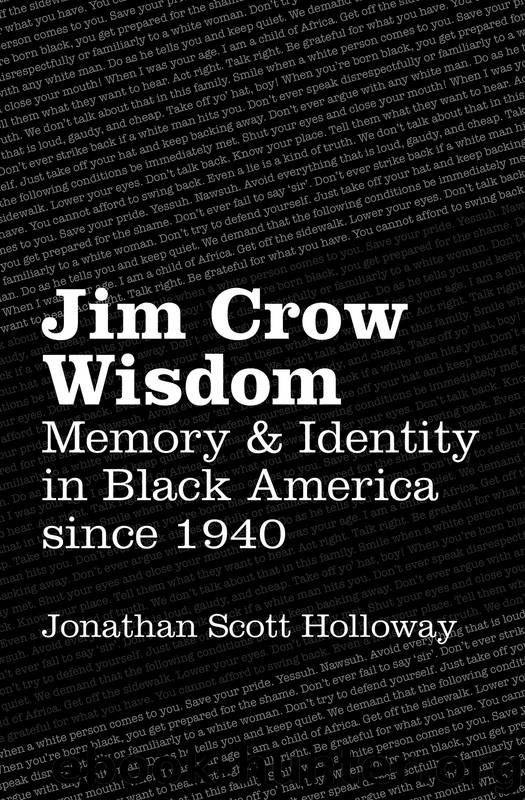
Author:Jonathan Scott Holloway
Language: eng
Format: epub
Publisher: The University of North Carolina Press
Published: 2013-04-05T04:00:00+00:00
5
THE SILENCES IN A CIVIL RIGHTS NARRATIVE
BILL T. JONES: Do you want your children to know pain?
ELIZABETH ALEXANDER: Yes, but I want to reserve the right to throw myself in front of the car.
BILL T. JONES: Can you throw yourself in front of history?
—Elizabeth Alexander and Bill T. Jones,
DeVane Lectures, Yale University
JAMES BALDWIN: Black people need witnesses; in this hostile world which thinks, um, everything is white.
INTERVIEWER: Are you still in despair about the world?
BALDWIN: I never have been in despair about the world, I’m enraged by the world.
INTERVIEWER: Enraged, alright.
BALDWIN: I don’t think I’m in despair. I can’t afford despair. I can’t tell my nephew, my niece; you can’t, you can’t tell the children there’s no hope.
—Film interview with James Baldwin,
James Baldwin: The Price of the Ticket
What do we tell our children? What stories do we pass along so that they know their history? It is unavoidable that they will learn the past that belongs to the nation, typically a mythic narrative of exceptionalism and universal citizenship. They will absorb the narratives in their school assemblies, through advertisements, and via the media. That past that belongs to an aggrieved people—in James Baldwin’s case and dare I say my own—is a different narrative. While the African American past is no less exceptional than the mythic American narrative of belonging, it is crafted in an often cruel juxtaposition to that same notion of belonging. Stories of denial need to be passed along, to be sure, but it is important to ask when and how our children need to learn that the American narrative may not belong to them.
During the height of Jim Crow, black parents had to prepare their children for a life of denial. Ray Sprigle, the journalist who crossed the color line in the late 1940s in an effort to understand the black experience, saw for himself that a child’s literal survival depended on this kind of education. But Sprigle also saw the way that black parents wrestled with the timing of that lesson. “When do you begin teaching your child how he is to live as a Negro?” Sprigle wondered. “When do you begin teaching him the difference between black and white—not as colors but as races? When do you begin teaching him how to live under the iron rule of a master race that regards him as an inferior breed? When do you begin teaching him that, for him, the Constitution and the Declaration of Independence are scraps of paper? Those are the questions that every Negro mother and father has to answer.”1
Wondering when and even what to tell the children resonates differently in the early twenty-first century than it did during the age of legally sanctioned racial segregation, when the systemic cultural practice of racial demarcation (what is often referred to as “racial etiquette”) flourished. Structured and informal systems of racial difference certainly still exist, but as a second generation of post–Civil Rights and Voting Rights Acts children grow up, as they see in the most
Download
This site does not store any files on its server. We only index and link to content provided by other sites. Please contact the content providers to delete copyright contents if any and email us, we'll remove relevant links or contents immediately.
| Africa | Americas |
| Arctic & Antarctica | Asia |
| Australia & Oceania | Europe |
| Middle East | Russia |
| United States | World |
| Ancient Civilizations | Military |
| Historical Study & Educational Resources |
Cat's cradle by Kurt Vonnegut(15383)
Pimp by Iceberg Slim(14545)
4 3 2 1: A Novel by Paul Auster(12423)
Underground: A Human History of the Worlds Beneath Our Feet by Will Hunt(12108)
The Radium Girls by Kate Moore(12047)
Wiseguy by Nicholas Pileggi(5802)
The Fire Next Time by James Baldwin(5461)
Perfect Rhythm by Jae(5421)
American History Stories, Volume III (Yesterday's Classics) by Pratt Mara L(5316)
Paper Towns by Green John(5202)
Pale Blue Dot by Carl Sagan(5026)
A Higher Loyalty: Truth, Lies, and Leadership by James Comey(4975)
The Mayflower and the Pilgrims' New World by Nathaniel Philbrick(4511)
The Doomsday Machine by Daniel Ellsberg(4500)
Killers of the Flower Moon: The Osage Murders and the Birth of the FBI by David Grann(4455)
The Sympathizer by Viet Thanh Nguyen(4408)
Too Much and Not the Mood by Durga Chew-Bose(4361)
The Borden Murders by Sarah Miller(4339)
Sticky Fingers by Joe Hagan(4212)
